Forward-deployed engineering: the model is the easy part
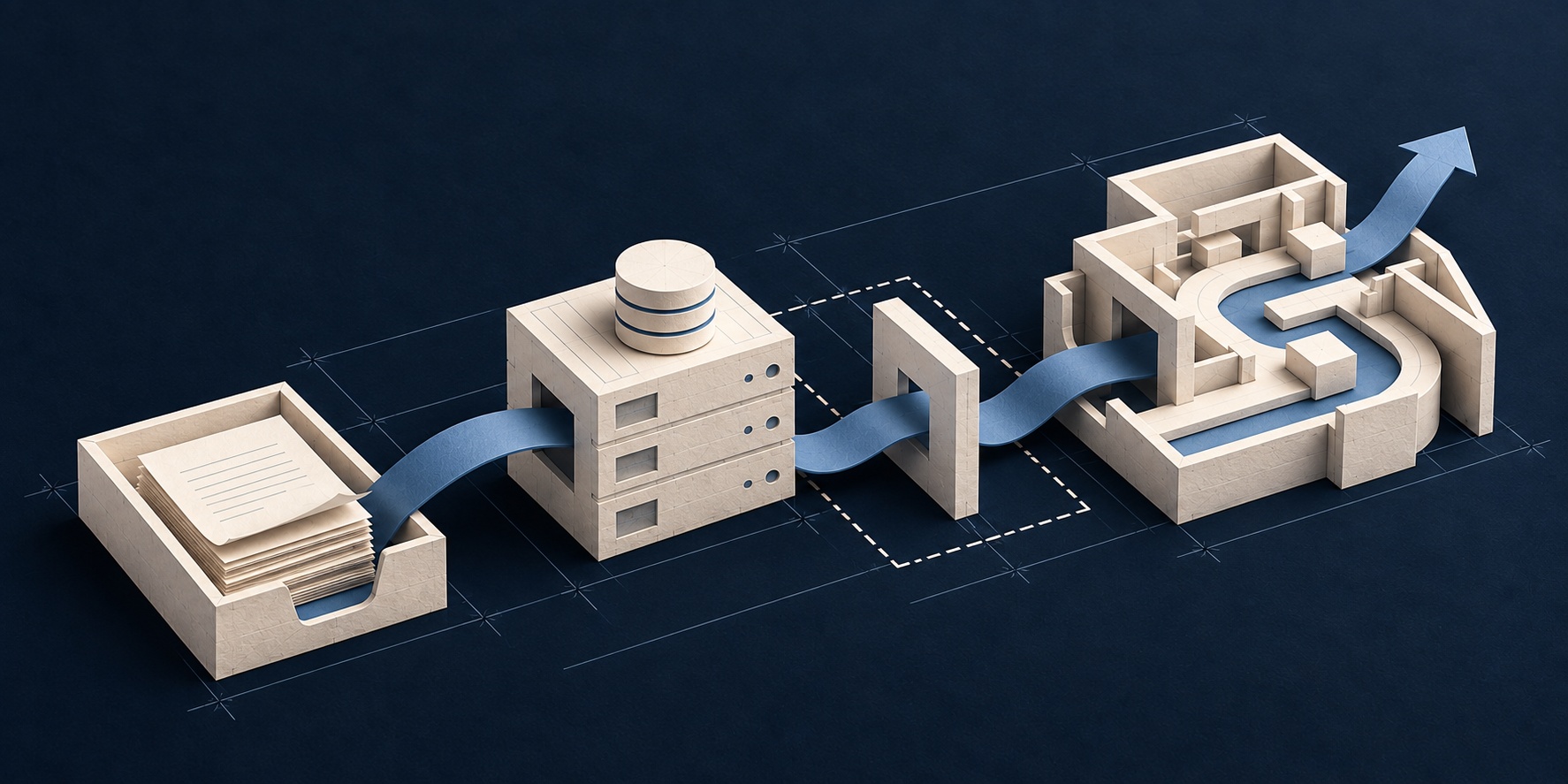
Your company already runs processes every day: people read emails, review documents, move information between systems, assemble reports, approve requests, and answer recurring questions. Some steps are automated. Others still depend on manual work.
If your team sees a use for AI, the practical question is where it belongs in that work.
A forward-deployed engineer works closely with customer users and systems to turn a business problem into working software. The role is broader than AI. In the established vendor model, engineers help customers use and extend the supplier's technology: Palantir's role description includes its platforms and custom applications; Anthropic's focuses on applications built with Claude and feedback to its product teams.
Start with how your work actually happens
The engineer needs to understand how work moves through your company:
- How does a customer request travel from inbox to resolution?
- Where do people copy or re-check the same information?
- Which systems must they switch between to finish one task?
- Where do mistakes happen, and who handles them?
That investigation should produce a map of your workflows: manual steps, existing automations, tools, data, and the people involved. A vendor platform may be part of the solution; your operating context still shapes what must be built.
Pick the few things worth automating
Someone extracts fields from documents and types them into another system. Support searches internal documentation before answering recurring questions. Operations compares systems by hand. Finance rebuilds a report from spreadsheets and email.
These are candidates to investigate. For each one, establish the time spent, the consequences of an error, and what a useful improvement would look like. AI or conventional automation might remove repetitive steps, connect information, or flag inconsistencies. Some tasks still need human judgment.
The goal is to automate the right things, with a way to check whether the change helps.
Carry the work through to delivery
Forward-deployed engineering combines understanding the problem with building, validating, and adapting the solution in the customer's environment. The scope can extend beyond configuration to application code and integrations.
Coding agents can help generate code, write tests, and read unfamiliar systems. Accountability remains with the engineers: architecture, requirements, security, validation, and production quality still need owners.
A role, not an engagement model
Forward-deployed engineering describes what an engineer does. Staff augmentation describes how an engineer joins your team. The two can overlap, but the title alone does not tell you who directs the work or owns delivery.
With Sophilabs Staff Augmentation, you set priorities and direct the engineer's work. If you need a team accountable for a defined result, our Product Development service may be the better fit. Before choosing either model, clarify scope, required access, delivery approval, and ownership of the handoff.
Give AI a controlled way into your systems
Sometimes the opportunity is making an existing system easier to use.
An MCP integration can expose specific operations from your platform to an AI application. MCP — the Model Context Protocol — defines interfaces for tools and data. For example, you could expose tools that let an authorized person ask:
"Show me customers with overdue invoices from the last 30 days."
"Create a follow-up task for these five accounts."
You choose which operations to expose. Your server must still enforce permissions and validate requests; sensitive changes need appropriate approval controls. MCP provides the interface, while your implementation determines what each user can read or change. The MCP tools specification describes those responsibilities.
What we learned doing it on our own platform
We run Sophilabs on an internal platform: CRM, projects, hiring, and this blog. We built an MCP integration for it. Our team uses Claude to create board tasks, register short links, and move internal knowledge into the platform.
In that integration, the difficult fixes were in our interface and business rules. An agent migrating our internal decision log encountered a validation demanding a field the integration could not write, server tools that had not reached the assistant, and a default marking entries "confirmed" without confirmation. Each required a change in our code.
This experience comes from our own operations. It illustrates why integrations need testing against actual workflows and rules.
The second lesson: record decisions, procedures, and rules where the next person or agent will look. That makes the work easier to continue and check.
AI becomes an operating capability
Start by asking which part of your operations should work better. A useful first project might reduce retyping, flag inconsistencies for review, or let your team query an existing system through a conversation.
Our AI Discovery Sprint gives you two weeks of work at a fixed price to map opportunities, assess feasibility, prioritize use cases, and scope a pilot. You keep the deliverables and can execute the roadmap with your own team.
The starting point is finding where your business should work better.